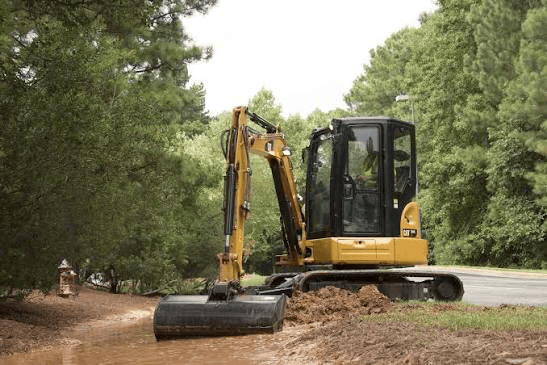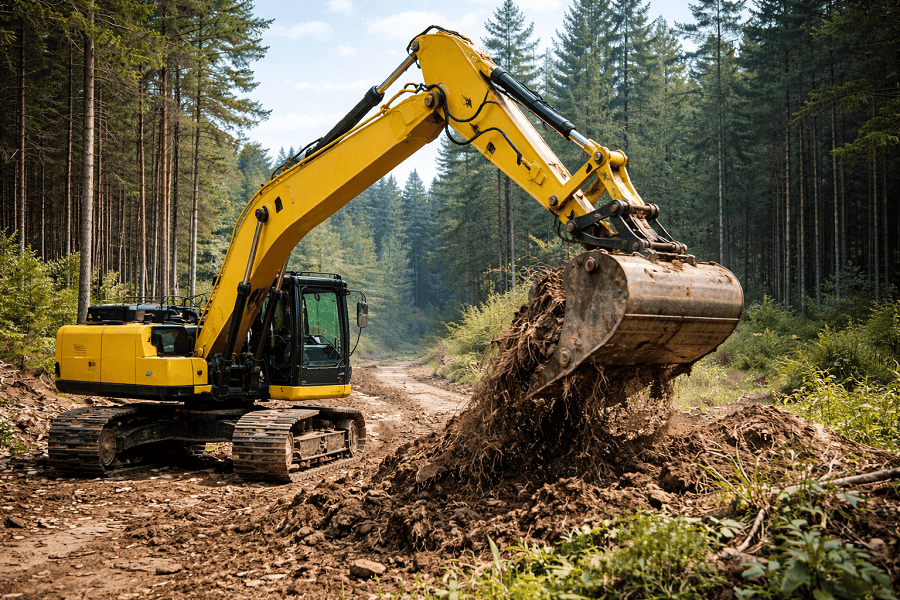

Not all excavation work requires a large excavator. In some projects where work space or area is limited, such as residential areas, utility project in the city center, building renovation, to landscaping work, usage mini excavator tend to be the wiser choice.
Although smaller in size, Mini excavators are still capable of carrying out various excavation jobs, material transfer, to disassembly with a high level of precision.
But, what is the actual function of a mini excavator?? What jobs can this tool do?? And what is no less important, when will a mini excavator be the best choice compared to a regular excavator??
This article will help you understand the use of a mini excavator in more depth so that you can determine whether or not this tool is suitable for the needs of the project you are going to carry out..
What is a Mini Excavator?
Mini excavators are compact hydraulic heavy equipment designed to carry out excavation and material handling work in areas with limited space. Mini excavators have an operational weight range from approx 1 until 8 tons with the same working system as a large excavator.
The difference between a mini excavator and a large excavator lies in size, turning radius, operational weight, and the ability to work in locations that are difficult to reach for large heavy equipment.
Because of its more compact size, Mini excavators are widely used in urban projects, housing, dense industrial area, underground utility work, to landscape projects that require a high level of precision.
The working principle of a mini excavator still relies on hydraulic power to move the boom, arm, bucket, and various other attachments so that it is able to produce a capable workforce even though the size of the tool is relatively small.
What a Mini Excavator Can Do?
The main function of a mini excavator is to carry out excavation work. But in field practice, This tool has capabilities that can be broader than just digging the ground.
Digging Trenches for Utilities and Drainage
One of the jobs that most often uses a mini excavator is making utility lines such as installing water pipes, power cable, telecommunications cable, as well as environmental drainage.
On a job like this, Accuracy of excavation dimensions is very important. Mini excavators can make it easier for operators to create more precise excavation paths than larger tools so that the risk of damage to facilities around the site can be minimized..
Because of the compact size of the tool, The use of a mini excavator can be applied in areas that have limited access without disrupting activities / surrounding project work processes.
Digging House and Building Foundations
Mini excavators are also widely used for residential foundation work, shophouse, warehouse, workshop, as well as medium-scale commercial buildings.
Compared to manual digging, using a mini excavator can speed up the work significantly. Besides being faster, Mini excavator excavation results also tend to be more consistent, making construction work easier at the next stage.
Assisting with Landscaping and Land Arrangement Work
On a landscaping project, Mini excavators are used to shape land contours, make a garden pond, dig a tree planting hole, and build drainage channels.
Mini excavators are easier to move in garden areas or areas that already have many landscape elements without causing excessive damage to the surrounding area.
Small Scale Land Clearing
For land clearing projects that are not too large, mini excavators can be used to clear bushes, remove small plant roots, digging the topsoil, and prepare the construction area.
Although its productivity is not as big as medium or large class excavators, Mini excavators tend to be chosen because they are considered more economical for projects with limited work areas.
Move the material
Apart from digging, Mini excavators are also often used to move excavated soil, pasir, gravel, and other construction materials in the project area.
This capability allows one tool unit to handle several types of work at once so that tool use becomes more efficient.
Breaker Function on Mini Excavator
The function of this mini excavator can also be expanded through the use of additional attachments. One attachment that can be used is a hydraulic breaker.
By installing a breaker attachment, mini excavator can be used for:
- Dismantling the concrete floor
- Breaking concrete roads
- Destroying old foundations
- Dismantling lightweight concrete structures
- Breaking rocks in certain construction jobs
Please remember that the working capacity of the hydraulic breaker on the mini excavator must be adjusted to the size of the unit. Mini excavators are more optimal for dismantling non-structural concrete or standard housing cement thickness. However, for thick reinforced concrete on a large infrastructure scale, still recommended to use class excavator breaker 10 ton or class excavator breaker 20 ton.
When Not to Use a Mini Excavator?
Although it has many advantages, mini excavators are not the best solution for all types of projects.
On jobs with very large excavation volumes, Using a mini excavator becomes less efficient because the bucket capacity and digging power are smaller than larger excavators.
Mini excavators are also not suitable for use on:
- Mining project
- Mass excavation
- Large scale cut and fill
- High volume excavation
- Continuous loading of large capacity dump trucks
Under these conditions, Medium or large class excavators are usually able to get the job done faster and more economically overall.
Mini Excavator vs Standard Excavator
Mini excavators excel in terms of flexibility, accessibility, and operational costs. On the contrary, Standard excavators are superior in productivity for large-scale jobs.
| Factor | Mini Excavator | Standard excavator |
| Narrow work area | Very good | Limited |
| Mobilization | It's easier | More complex |
| Operating costs | Lower | Higher |
| Precision work | High | Currently |
| Large excavation volume | Limited | Very good |
| Mass excavation productivity | Limited | Very high |
Because of that, Tool selection should be adjusted to field conditions and project productivity targets.
Choosing a Mini Excavator Based on Project Scale
Apart from understanding the function of the tool, The project owner also needs to choose the appropriate capacity of the mini excavator.
Mini Excavator Class 3 Ton
Mini excavator class 3 tons are generally used for:
- Stay-at-home work
- Environmental drainage
- Light utility installation
- Landscaping
- The access area is very narrow
Its compact size makes this tool ideal for jobs that require high mobility.
Mini Excavator Class 5 Ton
Mini Excavator Class 5 ton is the most flexible choice because it is able to handle various types of construction work.
This tool is suitable for use for:
- Shophouse construction
- Warehouse
- Workshop
- Light infrastructure
- Excavating commercial building foundations
Its larger capacity provides a balance between productivity and flexibility.
Mini Excavator Class 7,5 Ton
For projects that require greater digging power, class mini excavator 7,5 ton be the right choice. In the world of heavy equipment, This class is often also referred to as 'Midi Excavator’ because it bridges compact size with standard class productivity.
This class is widely used in:
- Area expansion
- Medium scale infrastructure
- Large drainage channel
- Preparation of construction land
- Industrial project
How much does it cost to rent a mini excavator per hour?
Mini excavator rental costs can vary depending on the capacity of the tool, project location, rental duration, type of work, as well as the attachments used.
In practice, Heavy equipment rental providers generally offer daily rental schemes, weekly, or monthly according to project needs. Therefore, The best way to get an accurate cost estimate is to adjust the tool capacity to the volume of work to be done.
Rent a Mini Excavator at PT Perkasa Sarana Utama
For those of you who need a mini excavator for construction projects, industry, utility, or demolition, PT Perkasa Sarana Utama provides a variety of unit options that can be adapted to work needs.
Available Mini Excavator Kubota U30 class 3 ton which is suitable for work in limited areas and small scale projects.
For more diverse needs available Mini Excavator Kubota U50 and Kobelco SK50 class 5 ton which is widely used in general construction projects, warehouse construction, and light infrastructure work.
Meanwhile, projects that require greater digging power can use Mini Excavator class 7,5 ton consisting of Kotrack KE75, Sany Sy75, Sumitomo SH75, and Sumitomo SH80.
PT Perkasa Sarana Utama also provides units Mini Excavator with Breaker Attachment class 5 tons as well 7,5 ton which is suitable for concrete demolition work, concrete road, and old foundation.
With a complete fleet choice, You can adjust tool capacity more precisely so that project productivity remains optimal without having to pay for unnecessary capacity.
Conclusion
The function of a mini excavator is not only limited to earth digging work. This tool is capable of handling various jobs such as making drainage, Foundation excavation, landscaping, light land clearing, material transfer, until dismantling using a breaker attachment.
Its main advantage lies in the ability to work in narrow areas, more efficient operational costs, as well as a high level of precision. However, Mini excavators are not always the best choice for all types of projects. For work with large excavation volumes and high productivity requirements, standard excavators are usually more effective.
By understanding the function, superiority, limitations, as well as available capacity, You can choose the mini excavator that best suits your project needs and optimizes work costs and productivity.
If you need a mini excavator rental, quick contact the PT Perkasa Sarana Utama team right now to get the best offers and unit availability this week.
WhatsApp: 0812-5233-3349
Email: rent@psualatberat.com
Website: psualatberat.com