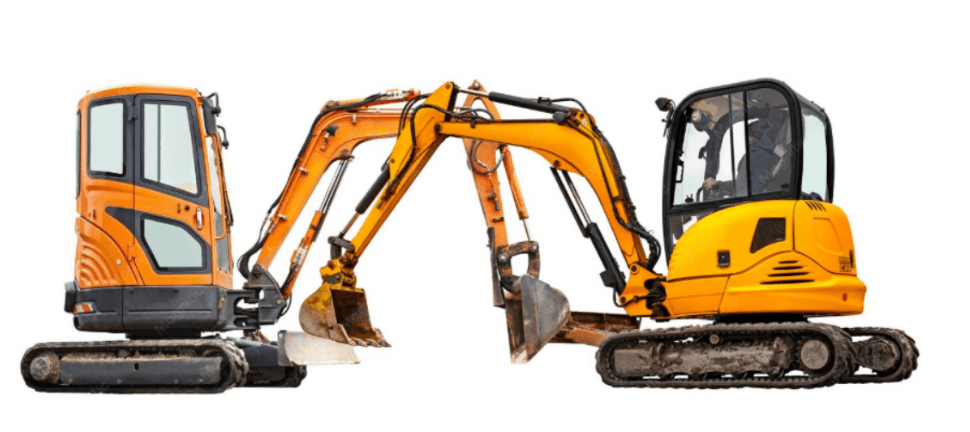
If you are going to work on a project, Choosing efficient heavy equipment is definitely your main consideration because this is related to rental costs and project operational costs.
One of types of heavy equipment that are often rented and consider its usefulness excavator.
Choosing an excavator cannot only be based on the size of the tool or the rental price alone. There are projects that use it more effectively excavator mini because the work area is narrow. But there are also jobs that require it big excavator because the volume of material and workload is much heavier.
Because of that, before deciding which tool to use, It is important for you to understand the differences between mini excavators and large excavators based on function and project needs.
Brief Differences between Mini Excavators and Large Excavators
Before discussing further, The following is a brief overview of the differences between mini excavators and large excavators which we have summarized in table form.
| Factor | Excavator Mini | Large Excavator |
| Weight Range | 1–7.5 ton | 10–50+ ton |
| Work Area | Narrow area | Large area |
| Working Capacity | Mild to moderate | Medium to heavy |
| Fuel consumption | More efficient | Higher |
| Bucket capacity | ±0,1 – 0,3 m³ | ±0,5 – 3 m³ |
| Mobilization | It's easier | Requires special trailer |
| Suitable for | Drainage, House | Cut and fill, quarry, wide land |
From the table above, it can be seen that mini excavators and large excavators are actually designed for different project needs.
To make it easier to understand the difference, Let's start by understanding the character of the mini excavator first.
What size mini excavator is it and what is its function?
Mini excavators generally weigh around 1–10 tons. But on everyday construction projects, the most frequently used units usually excavator 3-5 ton.
Because the size is compact, Mini excavators are easier to use:
- residential area
- drainage route
- urban projects
- garden
- utility installation (water pipe, drainage, underground power cable, gas pipe)
- and locations with limited access
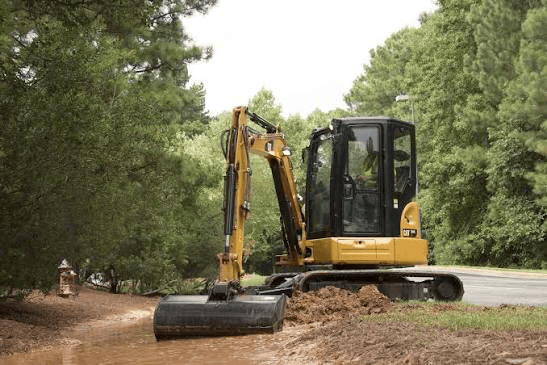
The most common example of using a mini excavator is a residential drainage project.
On a project like this, Large excavators usually have difficulty entering because the width of residential roads is designed to only be large enough for residential traffic, usually enough for 2 car lane.
The use of mini excavators has proven to be more effective in residential drainage projects because they are easier to move and do not require a large turning area when operating.
Besides that, Mini excavators also save fuel and mobilization costs.
However, mini excavators have less bucket capacity, lower digging energy, and a shorter digging reach. Therefore, Mini excavators are more suitable for small to medium scale projects.
Examples of projects that are suitable for using a mini excavator
| Type of project | Reasons to Use a Mini Excavator |
| Residential drainage | Narrow road access |
| House foundation | Limited work area |
| Installation of utilities | Requires more precise digging |
| Landscaping and gardens | The risk of area damage is smaller |
| Gardens and plantations | More flexible in narrow areas |
What size is a large excavator and what is its function?
Large excavators generally start at class 20 ton up.
This type of excavator is designed for work with large volumes of material and large project areas.
Because it has greater digging power and bucket capacity, Large excavators are more suitable for use:
- land clearing
- road project
- quarry / mining
- cut and fill work
- heavy earthmoving
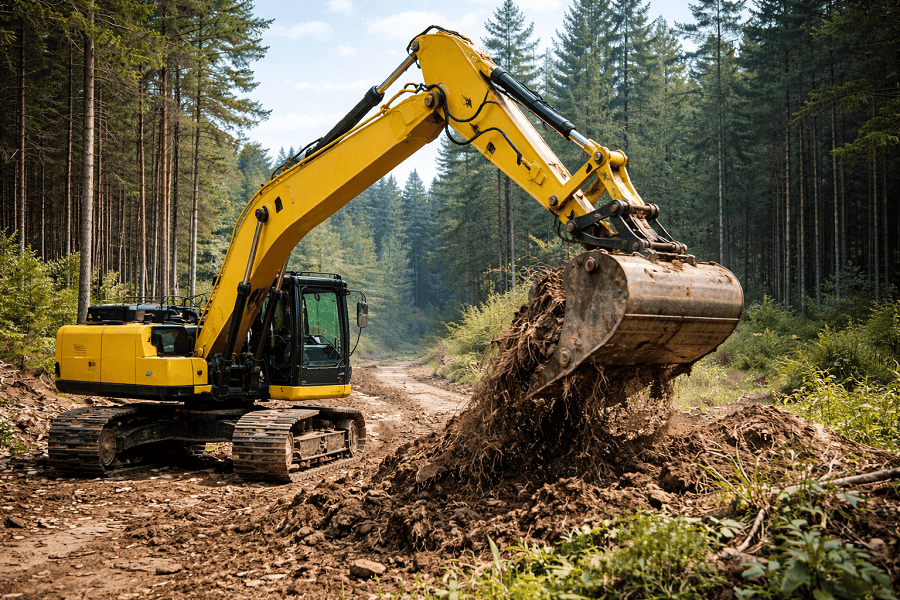
For example, on land clearing or cut and fill projects, A mini excavator will certainly take longer because the bucket capacity is smaller.
In conditions like this, Large excavators are much more efficient because they are able to move large amounts of material more quickly.
But large excavators also need it:
- wider work area,
- greater road access,
- and higher operational costs.
Examples of projects that are suitable for using large excavators
| Type of project | Reasons to Use a Large Excavator |
| Cut and fill | Large material volume |
| Land clearing | Requires high productivity |
| Quarry | Heavy material and large area |
| Road project | Requires a lot of digging power |
| Industrial area | Large scale work |
Mistakes in Choosing an Excavator that Often Occur
One of the most common mistakes is using a large excavator in a narrow area. as a result:
- the tool is difficult to move
- work is slow
- the risk of damaging the surrounding area increases
On the contrary, Using a mini excavator for large volume projects also often takes too long to work because its working capacity is more limited.
Therefore, before choosing an excavator, You have to consider:
- wide working area
- tool access
- volume material
- and project time targets
Which One Is More Suitable For Your Project?
If your project is in a narrow area like housing, drainage, or urban utilities, a mini excavator would be the most efficient choice.
However, if your project is land clearing, road work, or cut and fill with large volume, Large excavators are capable of doing projects much better than small excavators.
Conclusion
The difference between a mini excavator and a large excavator does not only lie in the size of the tool, but also on the function and character of the project that can be handled.
Mini excavators are more suitable for narrow areas and work that requires high flexibility.
Meanwhile, large excavators are more effective for projects with large work volumes and wider project areas.
By choosing an excavator that suits your project conditions, work can run faster, more efficient, and operational costs can be better controlled.
If you are still confused about choosing an excavator that suits your project needs, PT Perkasa Sarana Utama team can help provide tool recommendations based on field conditions and work targets.
PT Perkasa Sarana Utama (PSU) present to provide rental services excavator mini and big excavator with well-maintained units, ready for operation, and has gone through daily inspections (P2H) routine. Each unit is supported by regular maintenance according to technical standards, up to risk downtime in the middle of the project can be minimized.
Contact the PT Perkasa Sarana Utama team now for the best deals and unit availability this week.
WhatsApp: 0812-5233-3349
Email: rent@psualatberat.com
Website: psualatberat.com
FAQ
Can a mini excavator be used for hard ground??
Can, but for hard soil work in large volumes, Large excavators are usually more effective because their digging power is stronger.
Which is more cost effective?
Mini excavators are more fuel efficient and mobilized. But on large projects, Large excavators are often more efficient because the job is completed more quickly.
Can a mini excavator enter a narrow alley??
Of. One of the main advantages of a mini excavator is its compact dimensions, making it suitable for areas with limited access.