In construction projects and infrastructure development, The process of leveling the land surface requires large powerful heavy equipment and also has a high level of precision. Bumpy road, slope that needs to be adjusted, or even an uneven layer of aggregate can affect the final outcome of the project.
To produce a flat surface that is in accordance with the project blueprint, contractors use motor grader. This heavy equipment is known as one of the machines needed for grading work because it is able to form the ground surface with a level of accuracy that is difficult to achieve by other heavy equipment..
However, not all motor graders have the same characteristics. As innovation and project needs develop, Heavy equipment manufacturers develop various types of motor graders designed for terrain conditions, project size, and different productivity needs.
Therefore, Understanding the types of motor graders is important so that tool selection can be adjusted to work needs in the field.
What is a Motor Grader?
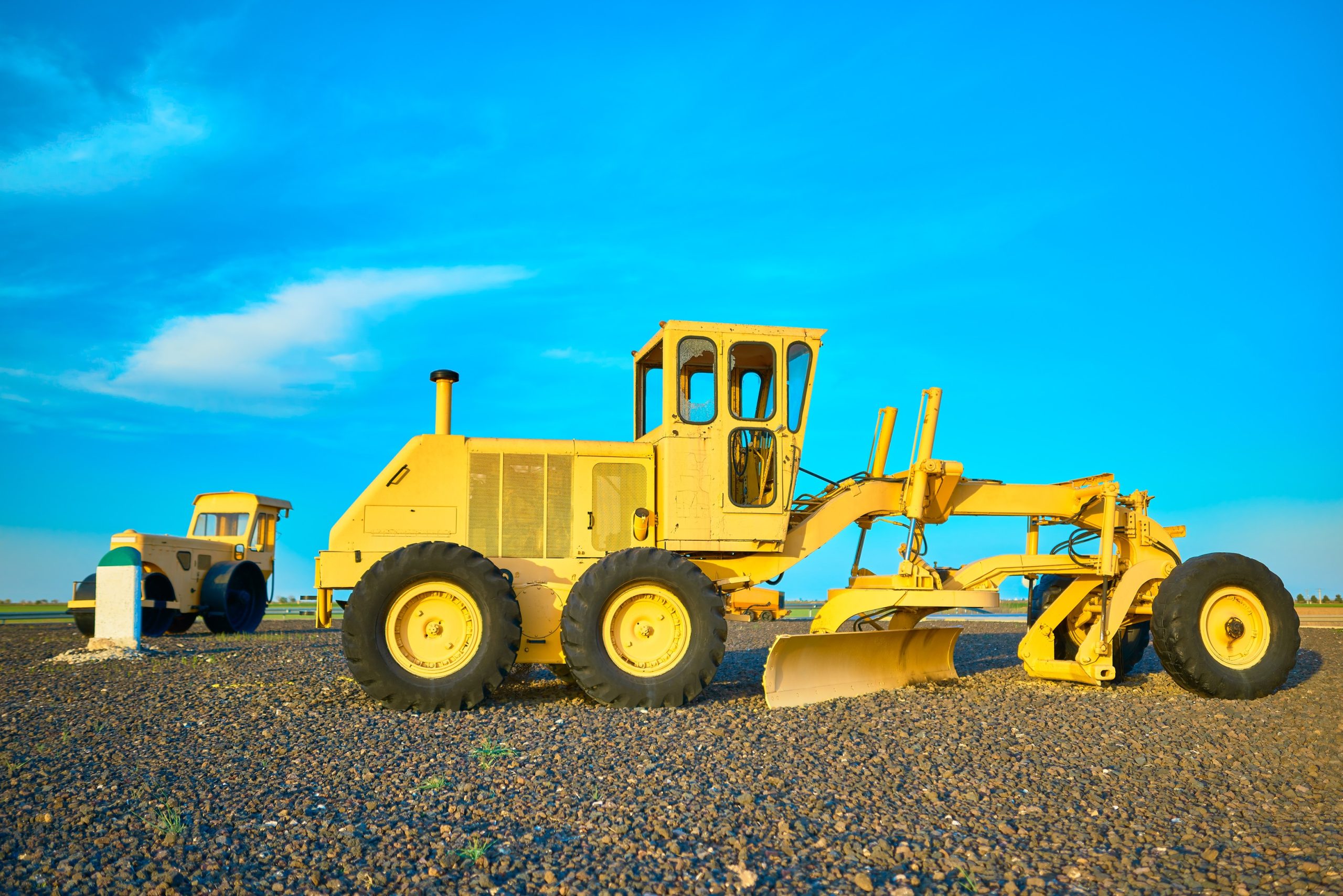
A motor grader is a heavy tool designed to level the surface of the ground, forming a slope (slope), create drainage channels, as well as carrying out finishing work on earth and aggregate work. The main characteristic of this tool is the blade or moldboard which is installed in the center of the unit and can be adjusted at an angle, position, and the height according to work requirements.
Different from bulldozer which is more effective for pushing large amounts of material, motor graders are used when a project requires more precise results. The operator can control the blade to shape the ground surface according to elevation and slope specified in the project design.
Motor graders are one of them heavy equipment used for road construction, mine road, industrial area, land clearing, airport construction, to maintenance of roads that are already in operation.
Why a Motor Grader is an Important Tool in Grading Work?
To understand why there are many types of motor graders, First, it is necessary to understand its role in a construction project.
On road work for example. Base soil layer, aggregate, and embankment materials must have elevations and slopes that are in accordance with the design. An error of just a few centimeters can affect the drainage system for the life of the road.
Motor graders help contractors achieve that level of precision more efficiently. Blade that can move in various directions. makes it easier for operators to cut parts of the ground that are too high, fill the part that is too low, while forming transverse and longitudinal slopes according to specifications.
Because project conditions vary greatly, starting from narrow neighborhood roads to large mining areas, Various types of motor graders have emerged with different designs and capacities.
Types of Motor Graders Based on Frame Design
One of the most commonly used classifications in grouping motor grader types is based on the design of the frame or tool frame.
- Articulated Frame Motor Grader
Articulated frame motor grader menggunakan sambungan artikulasi atau engsel di bagian tengah unit yang memungkinkan rangka depan dan belakang bergerak / turn separately.
This type of design provides a smaller turning radius than conventional graders so that the tool can turn more easily in areas that have curves or limited work space.. Apart from increasing the ability of movement flexibility, The hinge system also helps the operator to maintain the blade position more accurately when forming slopes or following certain terrain contours.
At the moment, Articulated frames are the type most widely used in construction projects because they provide flexibility, productivity, and an appropriate level of precision.
- Rigid Frame Motor Grader (Conventional Model)
Rigid frame motor graders have a straight frame without articulating joints / hinge, where the entire tool body works as one rigid unit. This type can actually provide good stability on long straight lines, it's just that the turning radius is bigger.
In today's construction industry, The rigid frame type has begun to be abandoned and is generally only found in older generation units or the used heavy equipment market, because its function has been replaced by an articulated frame which is much more flexible.
Types of Motor Graders Based on Size
Apart from the frame design, Motor graders are also differentiated based on their size and working capacity.
- Small Motor Grader
You can find small motor graders on small to medium scale projects that have limited work space. The more compact dimensions make this tool easy to maneuver on environmental roads, housing, plantation area, and landscape projects.
This small motor grader usually has a lower engine power 130 HP by blade length (knife) about 8–10 feet.
The production capacity is not as big as a large grader, but its efficiency is excellent for jobs that do not require high volumes of material.
- Medium Motor Grader
Medium motor graders are the most widely used category in the construction industry. The size and power of the machine is large enough to handle various grading jobs but is still easy to mobilize to various project locations.
Has a power range of 140–220 HP with a blade length of 12–14 feet, This medium motor grader is the most standard used for highway projects.
This type is often found in district road construction, industry, warehousing project, and land development work because it can provide a balance between productivity and flexibility.
- Large Motor Grader
Large motor graders are designed for projects with large work areas and large work volumes. With the above energy 250 HP and equipped by blades up to 24 paw, This Large Motor Grader is more productive for handling large amounts of material.
This type is commonly used in toll road projects, airport, mining, as well as the construction of large-scale industrial areas that require high productivity and completion times that must be on schedule.
Types of Motor Graders Based on Drive System
Apart from the size and design of the frame, Motor graders can also be differentiated based on the wheel drive system used.
- Rear-Wheel Drive / Tandem Drive
On this type of motor grader, Engine power is distributed to the four rear wheels via a tandem drive system. This configuration is the most commonly used industry standard because maintenance costs are considered more economical. This type is very effective for stable work fields, dry, and relatively flat.
- All Wheel Drive (AWD)
AWD or 6 motor grader×6 sending power to the front and rear wheels simultaneously. This system increases traction so the tool can work better on muddy terrain, slippery, sandy, or has a fairly high slope.
On mining projects, mountainous area, and areas with high rainfall, AWD motor graders are often the choice because they are able to maintain productivity in more challenging terrain conditions.
Compact / Mini Motor Grader
The development of the heavy equipment industry has also given birth to compact graders or mini motor graders which are smaller in size than conventional graders.
Although its working capacity is more limited, This tool can provide ease of mobilization and lower operational costs. Compact graders are widely used for environmental road maintenance, urban area, bicycle path, housing, as well as leveling work in areas that are difficult to access by standard graders.
The existence of compact graders shows that grading needs do not always require large equipment. Under certain conditions, Smaller tools can actually provide better efficiency.
How to Choose the Right Type of Motor Grader?
The selection of a motor grader should not only be based on the size of the tool, but also consider the characteristics of the project as a whole.
Wide working area be the first factor to consider. The wider the area to be leveled, the greater the grader capacity needed to maintain optimal productivity.
Terrain conditions also has a big influence on tool selection. For slippery terrain or low traction, AWD graders tend to have better performance than rear wheel drive types.
Besides that, the need for movement flexibility also needs to be considered. Projects that have lots of bends or narrow work areas are generally more suitable for using articulated frames because they are easier to control than rigid frames.
Final, project productivity targets should also be a primary consideration. Large-scale projects with tight schedules usually require a larger grader so that the work can be completed efficiently.
Technological Developments in Modern Motor Graders
Modern motor graders no longer rely solely on operator skill. Many heavy equipment manufacturers are now equipping their units with teknologi machine control to improve work accuracy and efficiency.
One technology that is increasingly being used is GPS Grade Control. This system can help operators know the blade position in real-time against the digital design of the project so that grading work can be carried out with a higher level of accuracy.
Besides that, some graders are also equipped laser control system and automatic blade control which helps maintain the design elevation without having to make many manual corrections.
Utilization of this technology can reduces the need for rework, increase productivity, and helps contractors achieve more consistent grading results.
Comparison of Motor Grader Types
| Category | Superiority | Limitations | General Application |
| Articulated Frame | High maneuverability and flexibility | More complex system | Road, industry, general construction |
| Rigid Frame | Stable on a straight line | Large turning radius & old technology | Open areas and linear work |
| Small Grader | Easy to maneuver and economical | Lower productivity | Neighborhood road, landscape |
| Medium Grader | Balance between capacity and flexibility | Not as strong as a large grader | General infrastructure |
| Large Grader | High productivity | Operational costs are greater | Toll road, mine, airport |
| Rear-Wheel (Tandem) | Operating costs & lower maintenance | Traction is limited in extreme terrain | Stable terrain, standard road project |
| AWD | Maximum traction on all terrain | Investment & higher maintenance | Smooth field, muddy, mining |
Conclusion
Motor graders are heavy equipment that play an important role in producing a level ground surface, stable, and according to project design specifications. As the needs of the construction industry develop, Various types of motor graders were developed to answer different work challenges.
Motor grader classification is not only limited to frame design, but also includes the size of the tool, drive system, to the development of compact graders which are increasingly popular on small scale projects. Furthermore, Technological advances such as GPS Grade Control and automatic blade control have also increased the accuracy and productivity of modern grading work.
The choice of motor grader must take into account terrain conditions, wide working area, maneuvering requirements, and productivity targets so that work can be completed effectively and efficiently.
Want to learn more about the world of heavy equipment? Visit other articles at PT Perkasa Sarana Utama website which discusses a lot about heavy equipment starting from excavator, wheel loader, vibro roller and various other heavy equipment used in construction project until mining.